
The Hidden Cost of Scattered Product Feedback
Your product feedback isn't missing. It's buried in 6 tools nobody cross-references. One request looks like six. Here's what that costs and how to fix it.

· Updated
Scattered product feedback is the condition where the same feature request, bug report, or customer insight exists across Slack, Zendesk, Salesforce, email, and other tools without any connection between them. It causes duplicate work, inflated or undercounted signals, and prioritization decisions based on incomplete data. Tools like IdeaLift solve this by aggregating feedback across 13+ channels into a single, evidence-weighted view.
Product feedback management vs feedback collection
The two get confused. They are not the same job.
Feedback collection is the act of gathering raw customer input from channels where it appears (support tickets, Slack, sales calls, email, NPS surveys, in-app widgets). Collection tools answer the question: "Did we capture it?"
Product feedback management is everything that happens after collection. Deduplication across channels, scoring by volume and strategic fit, routing to the right product area owner, turning customer signal into prioritized backlog items, preserving the decision when the team says yes or no, and closing the loop with the customer. Management tools answer the question: "Did it change what we build?"
Most teams have collection and think they have management. They do not. A support ticket tagged "feature request" that nobody cross-references with Slack, Salesforce, or the feedback portal is collected, not managed. Product feedback management is the discipline that turns five disconnected signals into one prioritized decision with a documented rationale. See our product feedback management guide for the full framework.
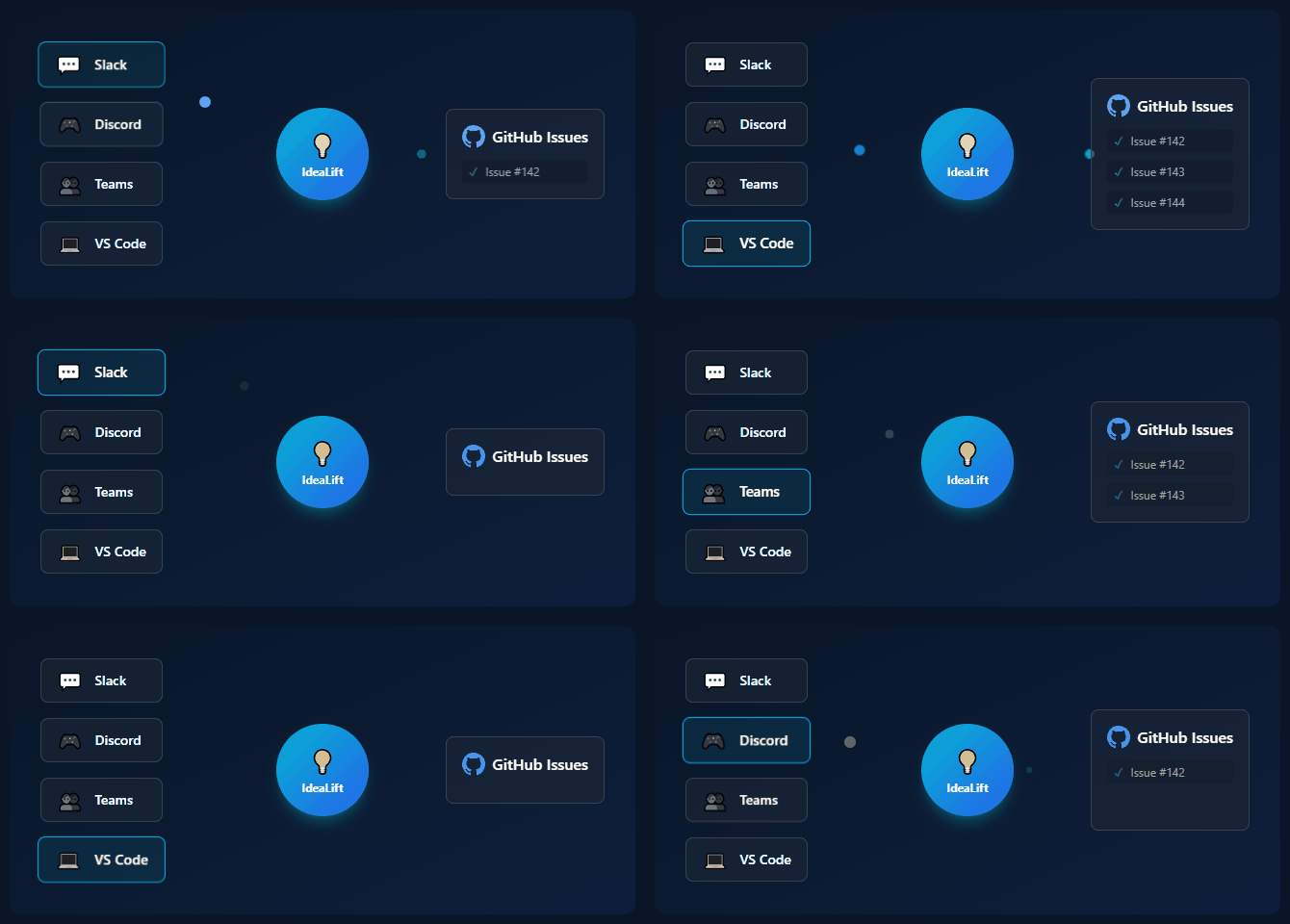
A customer tells your support team about a missing feature in Zendesk. A prospect mentions the same gap during a sales call logged in Salesforce. A power user drops the same request in a Slack channel. Three signals. One insight. Zero connection between them.
This is the default state of product feedback in most organizations. Not absent. Scattered.
Fragmentation is the real problem
Product teams don't have a feedback shortage. They have a feedback aggregation problem. Signals arrive through support tickets, NPS surveys, sales calls, Slack channels, email threads, community forums, and app store reviews. Each channel has its own tool. Each tool has its own silo.
The PM's job becomes archaeological. Dig through Zendesk for support patterns. Cross-reference with Salesforce deal notes. Check the Slack channel for recent mentions. Scan the NPS comments. Manually piece together whether these scattered signals point in the same direction.
Most PMs do this once per planning cycle. Maybe twice. The rest of the time, feedback sits unconnected in whichever tool captured it first.
Research shows that only 37% of meetings result in a clear decision, and 44% of action items are never completed. Feedback that arrives between planning cycles has even worse odds. It gets acknowledged, not acted on.
What fragmentation actually costs
Duplicate effort. Without aggregation, the same request shows up as three separate line items. Three different people investigate it. Three different threads of analysis run in parallel without anyone realizing they're solving the same problem.
Weak signal strength. One customer request is easy to deprioritize. Twelve customers requesting the same thing through different channels should be impossible to ignore. But if nobody connects the twelve signals, they each look like one. The loudest customer wins, not the most common need.
Lost context. A support ticket captures the complaint. It doesn't capture the Slack thread where three engineers discussed the underlying cause. It doesn't capture the sales call where a prospect explained they'd switch from a competitor if this feature existed. Each data point is accurate but incomplete. The full picture exists nowhere.
Reactive prioritization. When feedback is scattered, planning becomes a memory exercise. Which requests do we remember seeing? Which customers were loudest? This favors recency and volume over actual importance. The requests that got the most airtime in the last two weeks win. Everything else disappears.
Why feedback portals don't fix this
The standard solution is a feedback portal. Canny, UserVoice, Productboard. Give customers a place to submit requests. Let them vote. Problem solved.
Except it's not. Feedback portals capture maybe 5% of the signal. The other 95% still happens where it always did: in Slack threads, support tickets, sales calls, and email chains. People don't change behavior for a portal. They communicate where they already communicate.
Portals also introduce selection bias. The customers who bother to log in and submit a formal request are not representative of your entire user base. They tend to be your most engaged power users. The silent majority, the ones who churn without telling you why, never touch the portal.
So you end up with a feedback system that captures the vocal minority and misses everything else. It looks organized. It feels like progress. But it's a partial picture masquerading as the complete one.
Ambient capture changes the math
The only way to get full coverage is to meet feedback where it already happens. Monitor Slack, Teams, email, support tools, and sales platforms. Detect product-relevant signals automatically. Aggregate them into a single system of record without asking anyone to change their behavior.
This is the difference between a feedback portal and a feedback system. A portal waits for people to come to it. A system goes to where the feedback already is. For a practical guide to building this, see our ambient product feedback guide.
When you aggregate across channels, patterns emerge that were invisible before. That one-off support ticket becomes twelve signals from four channels pointing to the same gap. That feature request a PM deprioritized last quarter turns out to have been the top unaddressed signal for three months running. The data was always there. It just wasn't connected. We break down how to architect this in our feedback stack architecture for 95% capture.
From feedback collection to decision intelligence
Collecting feedback is step one. The real value is in what happens next. Connected signals need to flow into the decision process. When a PM sits down to prioritize, they should see the full weight of evidence behind each option. Not a remembered subset of it.
This is where feedback management becomes decision intelligence. It's not enough to know what customers are asking for. You need to know how those requests cluster, which ones are growing in urgency, and whether the decisions you've already made are holding up against the incoming signal.
Feedback that doesn't inform decisions is just noise with good intentions.
FAQ
What is the scattered feedback problem?
The scattered feedback problem is when customer signals arrive through multiple disconnected tools (Slack, Zendesk, Salesforce, email, NPS surveys) and no system connects them. The same request appears as separate items in each tool. Nobody sees the full picture, so prioritization decisions are based on whichever signals a PM happens to remember or encounter.
How does scattered feedback affect product decisions?
Scattered feedback distorts signal strength. A feature request mentioned by 12 customers across 4 channels looks like 4 separate low-priority requests instead of 1 high-priority pattern. Teams duplicate investigation effort, deprioritize common needs, and favor whoever was loudest most recently. The result is a roadmap shaped by recency bias instead of actual demand.
How do you consolidate feedback from multiple channels?
There are two approaches. Manual consolidation means a PM periodically searches each tool and manually cross-references signals. This works at low volume but breaks down past 50-100 signals per week. Automated aggregation tools like IdeaLift monitor Slack, Teams, email, Zendesk, Intercom, and other channels continuously, detecting product-relevant signals and grouping them without requiring anyone to change their workflow.
What tools aggregate product feedback automatically?
IdeaLift captures feedback ambiently from 13+ channels including Slack, Teams, email, Zendesk, and Intercom. Productboard aggregates signals but requires manual tagging. Canny and UserVoice only capture feedback submitted through their portals, missing the 95% of signals that happen in existing communication channels.
IdeaLift captures product feedback ambiently from Slack, Teams, email, Zendesk, Intercom, and more. No portals. No forms. It aggregates signals across channels, connects them to your decision history, and surfaces what matters before planning day. Start for free
Free Resource
Rescue Your Lost Feature Requests
A 5-step audit to find the ideas hiding in your team chat
Ready to stop losing ideas?
Capture feedback from Slack, Discord, and Teams. Send it to Jira, GitHub, or Linear with one click.
Continue Reading
View allBest Feature Request Tools 2026: IdeaLift, Canny, ProductBoard Compared
Best feature request tools 2026. IdeaLift, Canny, ProductBoard compared on capture discipline, pricing, and workflow. Pick the customer feedback tool that actually fits.
The Dark Matter of Product Feedback
80% of product feedback never reaches your portal. Learn where "dark matter" feedback hides and how to capture it from Slack, support tickets, and sales calls.
How to Prioritize Product Feedback Without Losing the Signal
A practical feedback prioritization system for product teams drowning in requests. Covers scoring models, common traps, and how to stop confusing volume with importance.