
Best Feature Request Tracking Software for Product Teams (2026)
Feature request tracking software, feature request management tools, and feature request portals compared. 8 options for product teams: pricing, Jira integration, customer portals, free tiers, and B2B fit.

· Updated
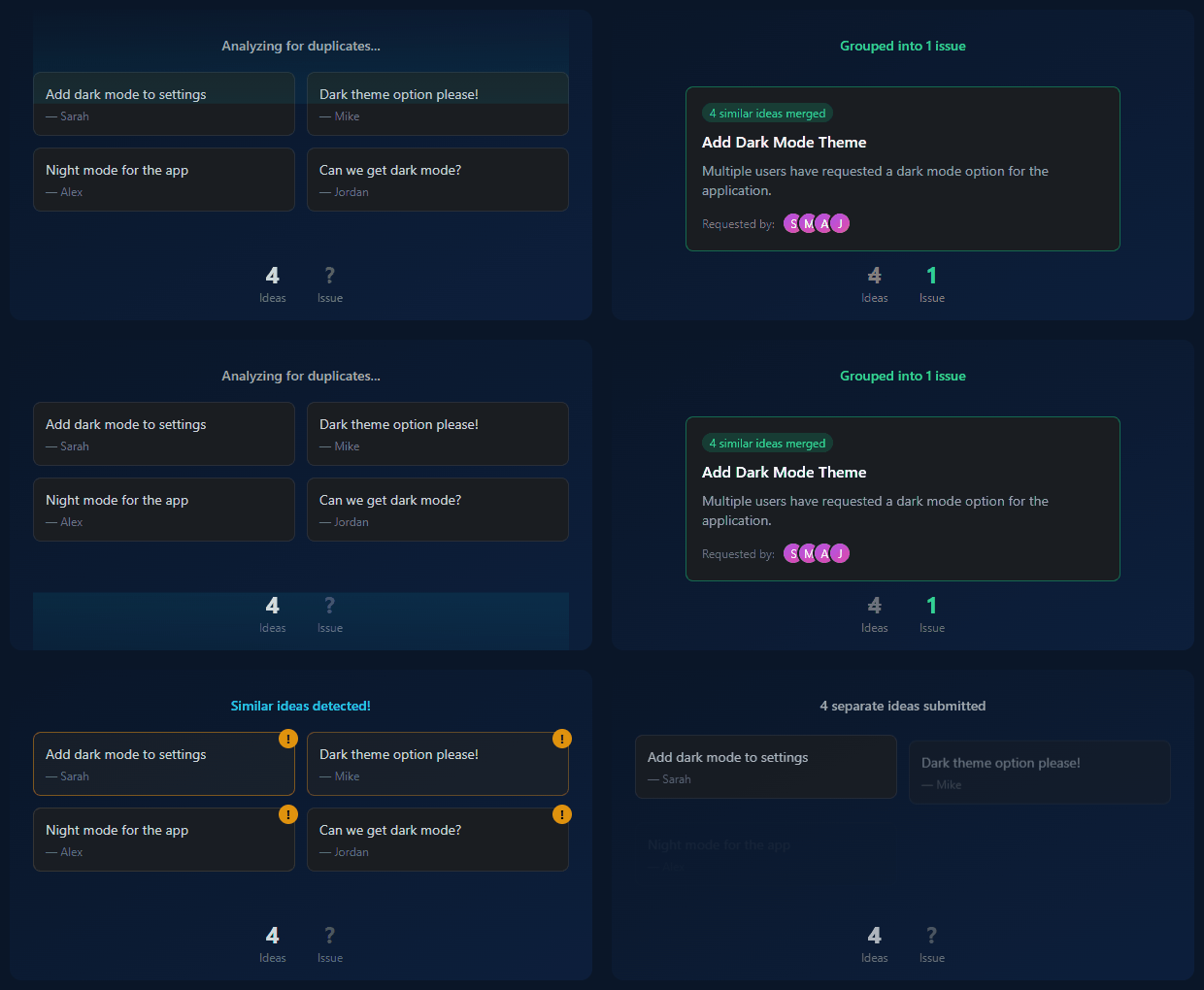
Feature request tracking software is a tool that captures, organizes, and prioritizes feature requests from customers, support tickets, Slack messages, sales calls, and other channels into a single backlog. The best tools in 2026 include IdeaLift (AI-powered, captures from 13+ channels), Canny (public voting portal), ProductBoard (enterprise roadmapping), and Fider (free open source). The right choice depends on where your requests originate and how much context you need to preserve.
What is feature request tracking software?
Feature request tracking software collects, organizes, deduplicates, and prioritizes feature requests from customers and internal teams in one place. It replaces scattered spreadsheets, buried Slack messages, and lost email threads with a single system where every request is captured, attributed to its source, and weighted by business impact.
Feature requests come from everywhere:
- Customers in support tickets
- Team members in Slack
- Sales calls and demos
- NPS surveys
- In-app feedback widgets
- Social media mentions
Without a system, most of these requests vanish. The same idea gets suggested 15 times. Nobody knows what customers actually want. Product decisions become guesswork.
Feature request tracking software solves this. It gives you a single place to capture, organize, prioritize, and act on feature requests.
What this category is also called
The same software category goes by many names. They all refer to the same thing — capturing, organizing, prioritizing, and acting on feature requests:
- Feature request tracking software — the most common buyer term
- Feature request management software / feature request management tool / feature request management system — emphasizes the workflow side
- Feature request portal — emphasizes the public submission and voting surface
- Feature request tracker / feature tracker — short-hand variants
- Feature request software / feature request tool / feature request tools — generic catch-all
- Feature tracking software / request tracking software — older terminology
- Feature request board — the kanban-style view of submissions
- B2B feature request tool — purpose-built for B2B teams where one $200K enterprise client outweighs 100 free-tier voters (see B2B Feature Request Tools: What's Different below)
- Customer feature request tracking — emphasizes the customer-feedback angle
In this guide we use feature request tracking software as the umbrella term and call out the differences where they matter.
This guide compares 8 leading options to help you find the right fit. For a broader look that includes survey and behavioral tools, see our best product feedback tools roundup. For direct head-to-head pages, see IdeaLift vs Canny, IdeaLift vs ProductBoard, IdeaLift vs UserVoice, or IdeaLift vs Aha! Ideas.
What to Look For
Before comparing tools, know what matters:
Essential Features
- Capture: Easy ways to add requests from multiple sources
- Deduplication: Merge duplicate requests, track counts
- Organization: Tags, categories, status workflows
- Prioritization: Voting, scoring, or ranking capabilities
- Integration: Connects to your dev tools (Jira, GitHub, etc.)
- Communication: Notify requesters when shipped
Nice-to-Have Features
- AI summarization for long requests
- Public voting portal
- Roadmap visualization
- Changelog for announcements
- Customer segmentation
- Analytics and reporting
Quick Comparison
| Tool | Best For | Capture Method | Jira Sync | Price |
|---|---|---|---|---|
| IdeaLift | Slack/Discord teams | Emoji reaction | Bi-directional | Free (Starter) |
| Canny | Public voting | Portal + widget | Yes | $79/mo |
| ProductBoard | Enterprise PM | Multiple sources | Yes | $20/user |
| Nolt | Simple voting | Portal | Basic | $29/mo |
| Sleekplan | Budget-conscious | Portal + widget | No | $13/mo |
| UserVoice | Large enterprise | Portal + SDK | Yes | $899/mo |
| Fider | Self-hosted | Portal | No | Free |
| Notion | DIY flexibility | Manual | Via Zapier | $10/user |
1. IdeaLift
Best for: Teams where feature requests happen in Slack, Discord, or Teams
Overview
IdeaLift captures feature requests directly from chat platforms. Instead of asking people to submit requests to a portal, you capture them where conversations already happen.
Key Features
- Emoji capture: React to any Slack/Discord message to capture it
- Thread context: Captures the full conversation, not just one message
- AI summarization: Long threads become clear descriptions
- Bi-directional Jira sync: Push to Jira, get notified when resolved
- Deduplication: AI detects similar requests
Pricing
- Free starter, $79/mo Pro, $199/mo Growth (flat, not per-user)
- All features included
- Free trial available
Pros
- Zero-friction capture from chat
- Full conversation context
- AI summarization is genuinely useful
- Flat pricing scales well
- Native Discord support (rare)
Cons
- No public voting portal
- Newer product
- Less robust roadmap/changelog features
Best For
B2B SaaS with active customer Slack channels, developer communities, internal product teams, teams tired of losing ideas in chat.
Verdict: Best-in-class for capturing from chat. If that's where your requests live, this is the answer. Teams that rely on Jira should also check our best Jira integrations for product managers.
2. Canny
Best for: Customer-facing voting boards
Overview
Canny is the market leader for public feature request voting. Customers submit ideas, vote on others' requests, and see your roadmap.
Key Features
- Public voting portal: Customers submit and vote
- Roadmap: Show what's planned, in progress, done
- Changelog: Announce shipped features
- Integrations: Jira, Intercom, Slack
- Private boards: For internal teams
Pricing
- $79/month flat
- Higher tiers for more features
- Free trial available
Pros
- Best voting experience
- Clean, modern design
- Good changelog feature
- Transparent roadmap builds trust
- Reasonable price
Cons
- Slack integration is basic (not true capture)
- No AI features
- Requires customers to visit another portal
Best For
B2C products, developer tools, and SaaS products where public feedback makes sense.
Verdict: The gold standard for public voting boards. For more options, see our Canny alternatives guide.
3. ProductBoard
Best for: Enterprise product teams
Overview
ProductBoard is a full product management platform. Feature request tracking is one piece of a larger suite that includes roadmapping, prioritization, and customer segmentation.
Key Features
- Multi-source capture: Email, Intercom, Zendesk, etc.
- Customer insights: Segment requests by customer value
- Prioritization: Built-in scoring frameworks
- Roadmapping: Multiple views and formats
- Jira sync: Two-way integration
Pricing
- $20/user/month (Essentials)
- Higher tiers for more features
- Adds up fast with larger teams
Pros
- Comprehensive feature set
- Customer segmentation is powerful
- Good integrations
- Modern, intuitive UI
Cons
- Per-user pricing gets expensive
- Learning curve
- Overkill for smaller teams
- Slack capture requires Zapier
Best For
Series B+ companies with dedicated product teams and budget.
Verdict: Best full-suite option if you can afford it. See our Productboard alternatives for similar tools.
4. Nolt
Best for: Simple, affordable voting
Overview
Nolt offers the core Canny experience at a lower price. Public boards, voting, status updates—no frills.
Key Features
- Voting boards: Customers submit and vote
- Custom domain: White-label option
- SSO support: Enterprise login
- Basic integrations: Webhooks, limited native
Pricing
- $29/month
- Simple pricing model
Pros
- Half the price of Canny
- Clean, focused experience
- Quick to set up
- Custom domain included
Cons
- Very basic features
- No Slack capture
- Limited integrations
- Smaller ecosystem
Best For
Small teams wanting public feedback without Canny's price.
Verdict: Good budget alternative to Canny.
5. Sleekplan
Best for: Maximum features at minimum price
Overview
Sleekplan offers voting, roadmap, and changelog at startup-friendly prices. Good feature density for the cost.
Key Features
- Voting boards: Customer feedback portal
- Roadmap: Public roadmap view
- Changelog: Release announcements
- Widget: Embed in your app
- SSO: Included on all plans
Pricing
- $13/month (Indie)
- $29/month (Pro)
- Very affordable
Pros
- Lowest price for full features
- Widget included
- SSO on all plans
- Good value proposition
Cons
- Less polished UI
- Smaller company
- Basic integrations
- No Slack capture
Best For
Bootstrapped startups watching every dollar.
Verdict: Best value for money if budget is tight.
6. UserVoice
Best for: Large enterprise
Overview
UserVoice is the OG feature request platform. Built for enterprise scale with in-app widgets, NPS, and compliance features.
Key Features
- In-app widget: Capture feedback inside your product
- Mobile SDKs: iOS and Android support
- SmartVote: AI-assisted prioritization
- Enterprise security: SOC 2, HIPAA
- NPS tracking: Built-in satisfaction surveys
Pricing
- $899/month starting
- Enterprise pricing
Pros
- Enterprise-grade security
- Scales to large user bases
- Mobile SDKs
- Deep analytics
Cons
- Very expensive
- Dated UI
- Long sales cycle
- Overkill for most teams
Best For
Enterprise companies (1000+ employees) with compliance requirements.
Verdict: If you're enterprise and need SOC 2, this is proven.
7. Fider
Best for: Self-hosted, free
Overview
Fider is open-source feature request software you can host yourself. Free forever—just pay for hosting.
Key Features
- Voting boards: Core functionality
- Comments: Discussion on requests
- Status updates: Track progress
- Self-hosted: Your servers, your data
Pricing
- Free (open source)
- You pay for hosting
Pros
- No subscription cost
- Full data ownership
- Open source (customizable)
- Good for privacy-sensitive teams
Cons
- Requires DevOps to deploy
- No support (community only)
- Limited features
- No integrations
Best For
Technical teams with hosting capability who want to avoid SaaS costs.
Verdict: Best free option if you're technical.
B2B Feature Request Tools: What's Different
B2B feature request tracking has requirements that consumer-facing tools don't handle well. When your customers are companies, not individuals, the dynamics change.
Account-level aggregation. A request from a $200K ARR account carries different weight than one from a free trial. B2B tools need to attribute requests to accounts, not just individuals, and weight them by revenue impact. ProductBoard and IdeaLift do this natively. Canny and Nolt do not.
Multi-stakeholder input. In B2B, the person using the product, the person who bought it, and the person who evaluates renewal are often three different people. Feature requests come from all three. The tool needs to capture who is asking and what role they play.
Sales-driven requests. B2B teams get feature requests from sales calls, QBRs, and renewal negotiations. These are high-context, high-stakes signals that can't sit in a Slack thread. They need to flow into the same system as product-initiated requests.
Closed-loop at scale. When you ship a B2B feature, notifying the 15 accounts that asked for it is a revenue retention action. The tool needs to route that notification to the right stakeholders, not just post a changelog.
| B2B Requirement | IdeaLift | Canny | ProductBoard | Savio |
|---|---|---|---|---|
| Account-level attribution | ✅ | ❌ | ✅ | ✅ |
| Revenue weighting | ✅ | ❌ | ✅ | ✅ |
| Slack/Teams capture | ✅ Native | ⚠️ Basic | ⚠️ Zapier | ✅ |
| CRM integration | ✅ HubSpot | ❌ | ✅ Salesforce | ✅ Salesforce |
| Closed-loop notifications | ✅ | ✅ | ⚠️ | ✅ |
For a process-focused guide on building the system around these tools, see our feature request tracking guide.
Open Source Feature Request Tracking Options
If you're looking for open source feature request tracking software, here are your main options:
Self-Hosted Open Source
- Fider (covered above) - The most popular open-source option. Simple voting boards, runs on Docker. Best for teams with DevOps capability.
- Astuto - Another open-source alternative with a cleaner UI than Fider
- FeatHub - Minimal feature request tracker, very lightweight
Partially Open Source
- Canny - Not open source, but offers a generous free tier
- Sleekplan - Closed source but very affordable ($13/mo)
Build Your Own
Many teams use open-source tools as building blocks:
- Notion + Make/Zapier automations
- GitHub Issues with custom labels and projects
- Discourse forums with voting plugins
Our recommendation: If you have DevOps capability and want open source, go with Fider. If you want features without maintenance, Sleekplan offers the best value. If your requests come through Slack/Discord, IdeaLift captures them natively with a free trial.
8. Notion
Best for: DIY flexibility
Overview
Notion isn't feature request software—it's a flexible database. But many teams build DIY tracking systems that fit their exact workflow.
How Teams Use It
- Create a database: Title, Description, Status, Votes, Requester
- Add views: Kanban by status, table for triage, calendar for roadmap
- Share with team or make public
- Manually manage workflow
Pricing
- Free for personal
- $10/user/month for teams
Pros
- Total flexibility
- Low cost
- Already using it (probably)
- No vendor lock-in
Cons
- No automation (without Zapier)
- No native voting
- Manual everything
- Requires discipline to maintain
Best For
Very early-stage teams who hate SaaS sprawl.
Verdict: Good if you're already in Notion and want to avoid another tool.
Feature Comparison Matrix
| Feature | IdeaLift | Canny | ProductBoard | Sleekplan | Nolt |
|---|---|---|---|---|---|
| Slack capture | ✅ Native | ⚠️ Basic | ⚠️ Zapier | ⚠️ Basic | ❌ |
| Discord capture | ✅ Native | ❌ | ❌ | ❌ | ❌ |
| Public voting | ❌ | ✅ | ⚠️ | ✅ | ✅ |
| Roadmap view | ❌ | ✅ | ✅ | ✅ | ❌ |
| Changelog | ❌ | ✅ | ⚠️ | ✅ | ❌ |
| AI features | ✅ | ❌ | ❌ | ❌ | ❌ |
| Jira sync | ✅ Two-way | ✅ | ✅ | ❌ | ❌ |
| Flat pricing | ✅ | ✅ | ❌ | ✅ | ✅ |
| Self-hosted | ❌ | ❌ | ❌ | ❌ | ❌ |
Decision Framework
By Primary Need
| Your Situation | Best Tool |
|---|---|
| Requests in Slack/Discord | IdeaLift |
| Want public customer voting | Canny |
| Need full PM suite | ProductBoard |
| Very tight budget | Sleekplan or Fider |
| Enterprise + compliance | UserVoice |
| Want total flexibility | Notion |
| Simple public board | Nolt |
By Company Stage
| Stage | Recommended |
|---|---|
| Pre-seed | Notion or Fider |
| Seed | IdeaLift or Sleekplan |
| Series A | IdeaLift or Canny |
| Series B+ | ProductBoard or Canny |
| Enterprise | ProductBoard or UserVoice |
By Integration Priority
| Need | Best Tool |
|---|---|
| Slack-native | IdeaLift |
| Discord-native | IdeaLift |
| Intercom | Canny or ProductBoard |
| Jira (two-way) | IdeaLift or ProductBoard |
| Zendesk | ProductBoard or UserVoice |
Implementation Checklist
For a complete framework on building your feedback system, see our product feedback management guide.
Week 1: Setup
- Choose tool based on this guide
- Set up account and basic configuration
- Define status workflow (New → Under Review → Planned → Building → Shipped)
- Import existing feature requests (export from current location)
Week 2: Capture Paths
- Set up Slack/Discord capture (if applicable)
- Add in-app widget or link to feedback portal
- Train support team on escalation process
- Announce to customers (if public portal)
Week 3: Process
- Schedule weekly triage (30 min, same time each week)
- Define prioritization criteria
- Set up notification templates (for status changes)
Week 4: Close Loops
- Send first batch of notifications to requesters
- Publish first changelog entry
- Review what's working and adjust
Common Mistakes
1. Choosing Based on Features, Not Fit
ProductBoard has the most features. But if you're a 5-person team, you're overpaying for complexity you won't use.
2. Ignoring Where Requests Actually Come From
If 80% of requests come through Slack, a portal-only tool won't capture them. Match the tool to your reality.
3. Not Defining a Process
A tool without a process is just another place for requests to die. Define who triages, how often, and what happens next.
4. Never Closing the Loop
The most powerful thing you can do: tell customers when their request ships. Most teams skip this. Don't.
Conclusion
Feature request tracking software ranges from free and DIY (Notion, Fider) to enterprise-grade (UserVoice, ProductBoard).
The right choice depends on:
- Where requests come from: Chat → IdeaLift. Public portal → Canny.
- Your budget: Tight → Sleekplan. Flexible → ProductBoard.
- Your scale: Small → Nolt. Enterprise → UserVoice.
Start with the problem: "Where are requests getting lost today?"
Then pick the tool that captures them with the least friction.
Losing requests in Slack? Try IdeaLift free →
FAQ
What is feature request tracking software?
Feature request tracking software is a tool that collects, organizes, deduplicates, and prioritizes feature requests from customers and internal teams. It replaces scattered spreadsheets, Slack messages, and email threads with a single system where every request is captured, attributed to its source, and weighted by business impact.
What is the best feature request tracking tool in 2026?
The best tool depends on your primary capture channel. IdeaLift is best for teams whose requests come through Slack, Teams, and internal conversations (AI-powered capture across 13+ channels). Canny is best for public-facing voting portals. ProductBoard is best for enterprise teams that need deep roadmapping integration. Fider is the best free, open-source option.
Do I need a dedicated feature request tool or can I use Jira?
Jira tracks work items after they are prioritized. Feature request tools track the signals that inform what gets prioritized. They solve different problems. Most teams use both: a feature request tool to capture and deduplicate feedback from multiple channels, then push validated requests into Jira for execution.
How much does feature request tracking software cost?
Pricing varies widely. Fider is free and open source. Sleekplan starts at $13/month. IdeaLift and Canny offer free tiers with paid plans starting around $39-79/month. ProductBoard starts at $20/user/month. UserVoice targets enterprise at $799+/month.
Free Resource
Rescue Your Lost Feature Requests
A 5-step audit to find the ideas hiding in your team chat
Ready to stop losing ideas?
Capture feedback from Slack, Discord, and Teams. Send it to Jira, GitHub, or Linear with one click.
Continue Reading
View allCentralized Feature Requests: Stop Losing Signal Across 12 Tools
Feature requests scattered across Slack, Zendesk, email, and Jira cost you roadmap accuracy. Here's how to centralize them into a single source of truth.
Best Feature Request Tools 2026: IdeaLift, Canny, ProductBoard Compared
Best feature request tools 2026. IdeaLift, Canny, ProductBoard compared on capture discipline, pricing, and workflow. Pick the customer feedback tool that actually fits.
7 Best Feature Request Tools for Product Teams in 2024
Compare 7 top feature request tools for 2024 including setup complexity, technical stack compatibility, and ROI analysis that most comparisons ignore.