
Canny Alternative: Feature Voting vs. Decision Memory
Canny tracks what customers ask for. It doesn't track what your team decides. That's a different problem and it needs a different tool.

A Canny alternative is a product feedback tool that solves one of three Canny gaps: portal-only capture (Canny only sees what people submit through its board), pricing, or the absence of internal decision tracking. IdeaLift fits teams whose feedback lives in chat rather than a portal and adds the decision memory Canny does not track; Featurebase, Nolt, and Fider fit teams that want a portal at a different price point.
The best Canny alternative depends on what you need beyond feature voting. If you need internal decision tracking and context preservation (what was decided, why, and what was rejected) IdeaLift fills the gap Canny leaves. If you need a public feedback portal with different pricing, look at Featurebase, Nolt, or Fider.
Canny works. If you want a public portal where customers submit feature requests, vote on each other's ideas, and see status updates when you ship something, Canny handles that cleanly. The interface is good. The concept is sound.
But teams looking for a Canny alternative usually hit a specific wall. At some point they realize that vote counts don't explain decisions. High-voted features get deprioritized without explanation. Low-voted requests get built because one key enterprise customer asked. The "why" is invisible. And none of what happens internally, the Slack debates, the PM's reasoning, the trade-offs discussed in sprint planning, ever flows back into Canny.
That's the core limitation. Canny captures what customers express. It doesn't capture what teams decide. Those are two different problems.
What Canny does well
Canny is good at collecting and organizing customer-facing requests. Its public board is easy for customers to use. Upvotes give you a rough signal of demand. The changelog lets you close the loop with customers when you ship.
If your primary need is a structured channel for customers to submit ideas, and you want to show customers which requests are planned or in progress, Canny fills that role. The pricing is reasonable. The setup is fast.
Where it falls short
Three things Canny structurally cannot solve:
-
Internal decisions are invisible. The conversation where your team decided to deprioritize the top-voted feature? Not in Canny. The PM's reasoning? Not in Canny. The sales call where an enterprise account's request overrode the vote count? Not in Canny. Canny's record starts when a customer submits something and ends when you change the status. Everything that happens between your team and the backlog is undocumented.
-
Only submitted ideas exist. Canny captures what customers choose to submit through the portal. It doesn't capture conversations in Slack, support tickets that never made it to the board, or signals buried in email threads. The customer who called your support line and described the exact same issue doesn't show up in the vote count. You're making priority decisions based on a biased sample.
-
No decision audit trail. Six months after deprioritizing a feature, someone new asks why. The vote count is still there. But the reasoning, who was in the room, what alternatives were considered, what tradeoff was made, is gone. Canny has no mechanism to preserve that. You have to look it up in Slack (if you can find it) or ask whoever made the call (if they're still around).
Canny solves feedback collection. It doesn't solve decision memory. If your team keeps re-debating decisions, losing context between meetings and tickets, or building the wrong things because the "why" never traveled from discussion to backlog, that's not a Canny gap. That's a different product category entirely.
Canny alternatives, compared
Featurebase
Featurebase is the most common Canny alternative cited by teams on a budget. Similar public voting board, changelog, and status updates, but at a lower price point. The core limitation is identical to Canny: it manages what customers submit, not what teams decide internally.
Good for: Teams looking for Canny at lower cost. Same use case, different price.
UserVoice
UserVoice is one of the oldest players in feedback management. More enterprise-oriented than Canny, with more integrations and reporting. Still built on the same premise: customers submit feedback through a portal, teams triage and prioritize. See our UserVoice alternative comparison for the decision-layer angle.
Good for: Enterprise teams that need formal feedback workflows and compliance-friendly reporting.
Productboard
Productboard does more than Canny. It aggregates customer signals, connects them to features, and integrates with project management tools. It still requires someone to manually tag and route inputs. Automated capture from Slack or email is limited without heavy configuration.
Good for: Teams that want to tie customer signals directly to a structured roadmap.
IdeaLift
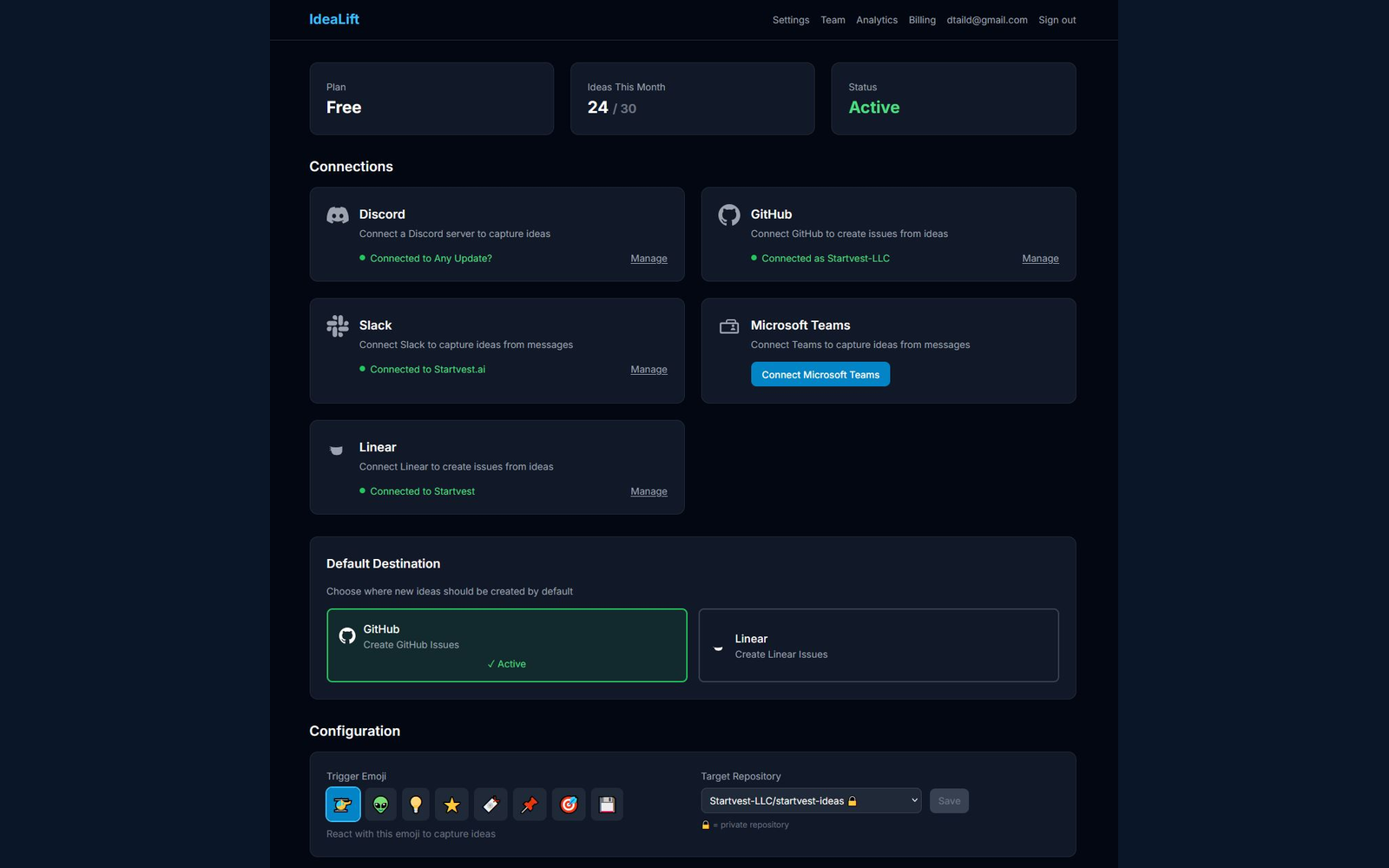
IdeaLift solves a different problem than Canny. Canny manages the customer-facing feedback channel. IdeaLift manages what happens inside your team: the decisions made in Slack, Teams, email, and meetings that eventually become (or don't become) backlog items.
IdeaLift captures decisions ambiently. No one fills out a portal. No one logs anything manually. When a decision occurs in a Slack thread or a Teams call, IdeaLift identifies it, preserves who was involved, what was decided, and what alternatives were rejected. That record stays attached to the decision. Six months later, when someone asks why you went with option B, the answer is in IdeaLift.
If you're already using Canny for customer feedback and want to fill the internal gap, IdeaLift adds that layer without replacing Canny.
Good for: Teams losing decisions between conversations and tickets, regardless of what feedback tool they use.
Feature comparison
| Feature | Canny | Featurebase | Productboard | IdeaLift |
|---|---|---|---|---|
| Customer voting portal | Yes | Yes | Yes | No |
| Ambient internal capture | No | No | No | Yes |
| Decision audit trail | No | No | Partial | Yes |
| Decision decay detection | No | No | No | Yes |
| Slack/Teams integration | Webhook only | Webhook only | Manual input | Native |
| Pricing start | $79/mo | $49/mo | $20/user/mo | Free (Starter) |
These tools solve different jobs. Canny and its alternatives manage what comes in from customers. IdeaLift manages what happens internally before it reaches the backlog. Most teams eventually need both layers.
Which one is right?
If you need a customer-facing feedback portal with voting and a changelog: Canny, Featurebase, or UserVoice. The main differentiator between them is price and enterprise features.
If you need to tie customer signals directly into a structured roadmap: Productboard.
If you need to stop losing internal decisions between your team's conversations and your backlog, regardless of what customer-facing tool you use, that's IdeaLift.
You can run IdeaLift alongside Canny. They're not competing for the same job.
Related reading: For the full 7-tool comparison with pricing tables and migration tips, see our comprehensive Canny alternatives guide. Or browse all options in our best product feedback tools roundup.
FAQ
What is the best alternative to Canny?
It depends on your gap. For a cheaper public voting portal, Featurebase or Nolt. For enterprise feedback workflows, UserVoice or Productboard. For internal decision tracking and context preservation that Canny does not offer at all, IdeaLift. Most teams switching from Canny need something Canny structurally cannot do, not just a different version of the same thing.
What does Canny not do?
Canny does not capture internal team decisions. It has no record of why a feature was deprioritized, what alternatives were discussed, or who made the call. It only tracks what customers submit through the portal, missing signals from Slack, support tickets, sales calls, and email. There is no decision audit trail and no way to detect when an old decision needs revisiting.
Can you use IdeaLift with Canny?
Yes. They solve different problems. Canny manages your public-facing feedback portal where customers vote on feature requests. IdeaLift manages the internal layer: decisions made in Slack, Teams, email, and meetings. Teams run both tools without conflict. Customer signals in Canny and internal decisions in IdeaLift.
How much does Canny cost vs alternatives?
Canny starts at $79/month. Featurebase starts at $49/month for similar portal functionality. UserVoice is enterprise-priced (custom quotes). Productboard starts at $20/user/month. IdeaLift is not a direct Canny replacement since it solves a different problem (internal decisions vs. public voting), but it starts at a comparable price point for teams that need the decision layer Canny lacks.
IdeaLift captures the decisions, debates, and context that every other tool skips. No new workflow. No portal for your team to fill in. Start free at idealift.app
Free Resource
Rescue Your Lost Feature Requests
A 5-step audit to find the ideas hiding in your team chat
Ready to stop losing ideas?
Capture feedback from Slack, Discord, and Teams. Send it to Jira, GitHub, or Linear with one click.
Continue Reading
View all7 Best Canny Alternatives in 2026 (With Honest Comparison)
Looking for Canny alternatives? Full 2026 comparison of 7 feedback tools with pricing, pros/cons, and head-to-head breakdowns. Canny vs IdeaLift, ProductBoard, UserVoice, and more.
IdeaLift vs Canny: Portal-Based Feedback vs Conversation-Based Capture
IdeaLift and Canny take fundamentally different approaches to product feedback. One uses voting portals. The other captures signals from your existing conversations. Here's how to choose.
Nolt vs Canny: Voting Portal Comparison (2026)
Nolt vs Canny is the indie-vs-incumbent decision in customer feedback portals. Nolt is cheaper and simpler. Canny is more polished with deeper integrations. Here is the honest breakdown.